Mobile RV Detailing & RV Wash in Phoenix, AZ
Professional mobile cleaning and detailing for motorhomes, fifth wheels, and travel trailers across Phoenix and the surrounding Valley. We bring the equipment to your RV at a suitable home, private pad, storage, or commercial location — mobile service, motorhomes and trailers, Phoenix and surrounding Valley.
An RV is not a large car. The surface area is measured in hundreds of square feet, the working height puts most of the coach above shoulder level, and a single unit can combine gel coat, painted panels, vinyl decals, rubber seals, plastic trim, aluminum siding, oversized glass, and heavy commercial wheels — each with different chemical tolerances. That is why the same aggressive approach that gets a pickup clean in an hour can dull decals, streak gel coat, or force water past a seal on a motorhome.
We quote RV work by the coach in front of us, not by a length chart. A 25-foot trailer that gets washed every few weeks and a 40-foot Class A that has sat outdoors through a full Phoenix summer are fundamentally different jobs, and pretending otherwise produces either a bad price or a bad result.
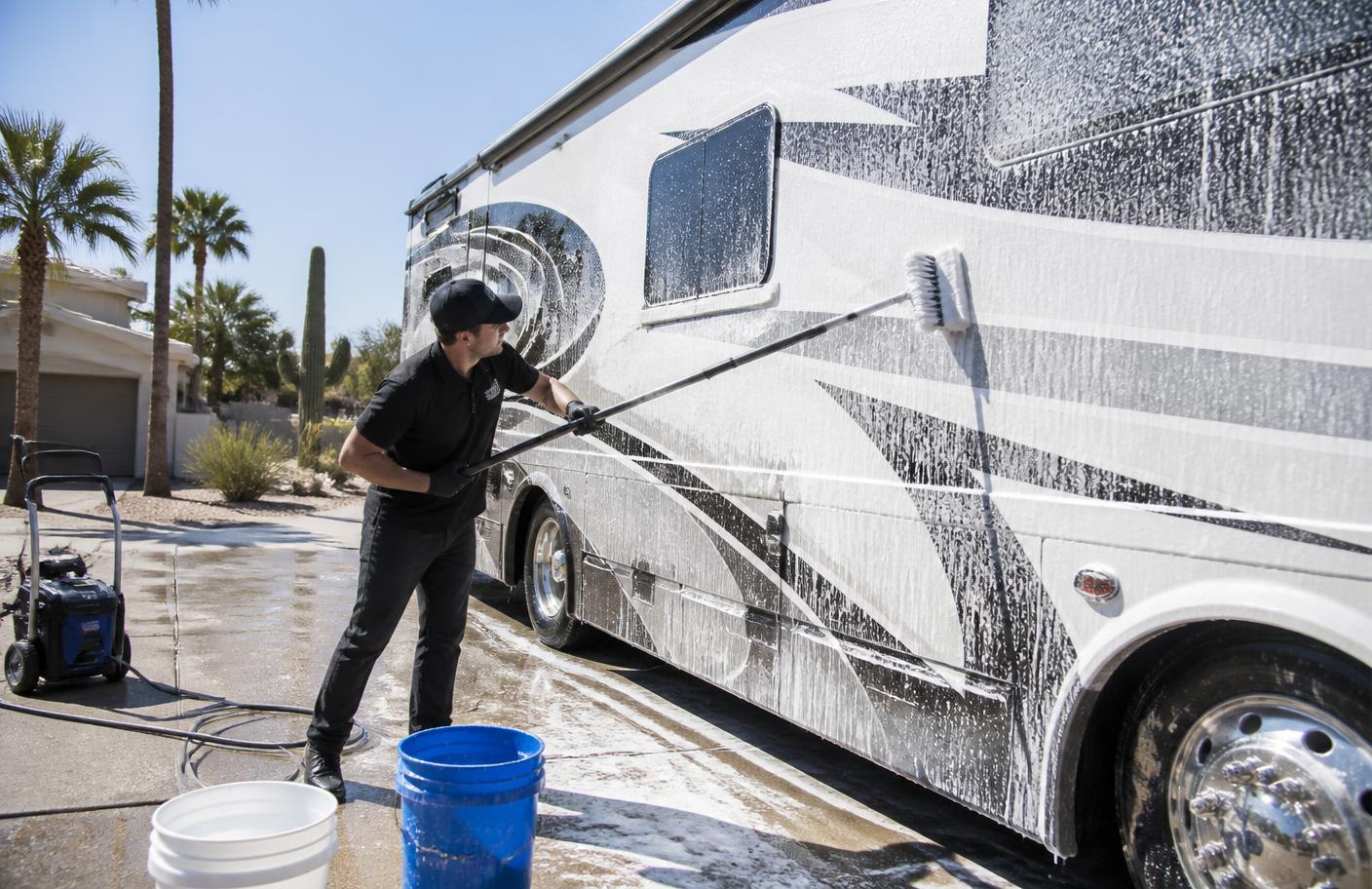
Process
How a mobile RV appointment runs
Step 1
Pre-inspection
We walk the coach with you: surface types, oxidation and chalking, black streaking, bug load on the front cap, seal condition, and what upper-surface access is realistic at your location.
Step 2
Access and setup
We confirm working room on all sides, staging for equipment, and where runoff will go. Covered storage spaces and tight side yards change what can be reached safely.
Step 3
Controlled rinse
Top-down rinse at controlled pressure to carry off loose desert dust before anything touches the surface. High pressure near seals, decal edges, and vents is avoided.
Step 4
Surface-appropriate wash
Dedicated RV soap, soft media, and clean water, worked in sections from the roofline down so dirty runoff never dries onto cleaned panels.
Step 5
Front and rear caps
Bug residue on the front cap, mirrors, and windshield surround is softened with appropriate chemistry and dwell time rather than scrubbed off dry.
Step 6
Black streak treatment
Roofline, awning rails, window frames, and drainage areas get targeted streak treatment where an ordinary wash will not lift the staining.
Step 7
Wheels, tires, and skirts
Brake dust, road film, and lower-panel grime are cleaned with pH-appropriate products, then tires are dressed with a water-based product where requested.
Step 8
Glass and trim
Oversized windows, entry glass, and trim are cleaned last so streaking from earlier stages is removed rather than reintroduced.
Step 9
Drying
Large panels are dried deliberately — Valley water is hard, and letting a 300-square-foot sidewall air-dry in the sun is how mineral spotting gets built in.
Step 10
Optional protection
Where the surface is compatible and in reasonable condition, a wax or sealant can be applied to add sacrificial protection and make the next wash easier.
Step 11
Interior work if included
Vacuuming, hard surfaces, upholstery, interior glass, and entry areas, scoped and agreed before the appointment rather than assumed.
Step 12
Final walkthrough
We go back over the coach with you and are direct about what improved, what did not, and what would need a specialist.
What you get out of it
- Service at your driveway, private RV pad, storage space, or business lot
- Surface-appropriate chemistry for gel coat, decals, seals, and trim
- Black streak and bug-residue treatment beyond a basic rinse
- Wheels, tires, lower skirts, and oversized glass included in exterior work
- Optional exterior protection to make future washes less labor-intensive
- Interior cleaning available where the scope is agreed in advance
Realistic expectations
- — A wash removes contamination; it does not repair heavy oxidation, chalking, failing gel coat, or cracked decals.
- — Roof and upper-surface work depends on coach height, roof construction and condition, clearance, and safe access — it is scoped per RV, not promised by default.
- — Not every HOA, storage facility, or commercial property allows mobile detailing or wash runoff; permission should be confirmed before booking.
- — Black streaks can return if the runoff source above them continues producing them.
- — Structural fiberglass, roof membrane, seal, paint, and body damage need an RV repair specialist rather than a detailer.
Local context
What Phoenix does to an RV
Sun is the dominant factor. An RV presents an enormous, mostly horizontal or high-facing surface — roof, upper sidewalls, front and rear caps — to a sun load that runs for months. That exposure oxidizes gel coat, chalks white surfaces, fades decals, dulls painted panels, and dries out rubber seals and plastic trim. Detailing can clean and, in some cases, improve those surfaces; it cannot reverse every stage of sun damage.
Dust is the daily factor. Fine desert dust settles constantly and collects heaviest along the roofline, around window frames, in seal channels, and behind trim. On an RV stored outdoors for a season, that accumulation is measured in layers, not in a film.
Water is the sneaky factor. Valley tap water is mineral-heavy, and sprinkler overspray plus hose washing leaves spotting and streaking that shows badly across large flat sidewalls and glass. Monsoon storms then combine airborne dust with rain and leave muddy runoff streaks that dry onto the exterior within minutes on a hot panel. Highway travel adds baked bugs on the front cap, road film along the lower panels, contamination on the rear cap, and brake dust on the wheels.
Mobile service
Mobile RV detailing in Phoenix
Taking an RV somewhere to be cleaned is its own project. You have to pull it out of storage, drive a 30- or 40-foot coach across town, wait, and put it back. Mobile service removes all of that: the equipment comes to the RV, and in most cases the coach never moves.
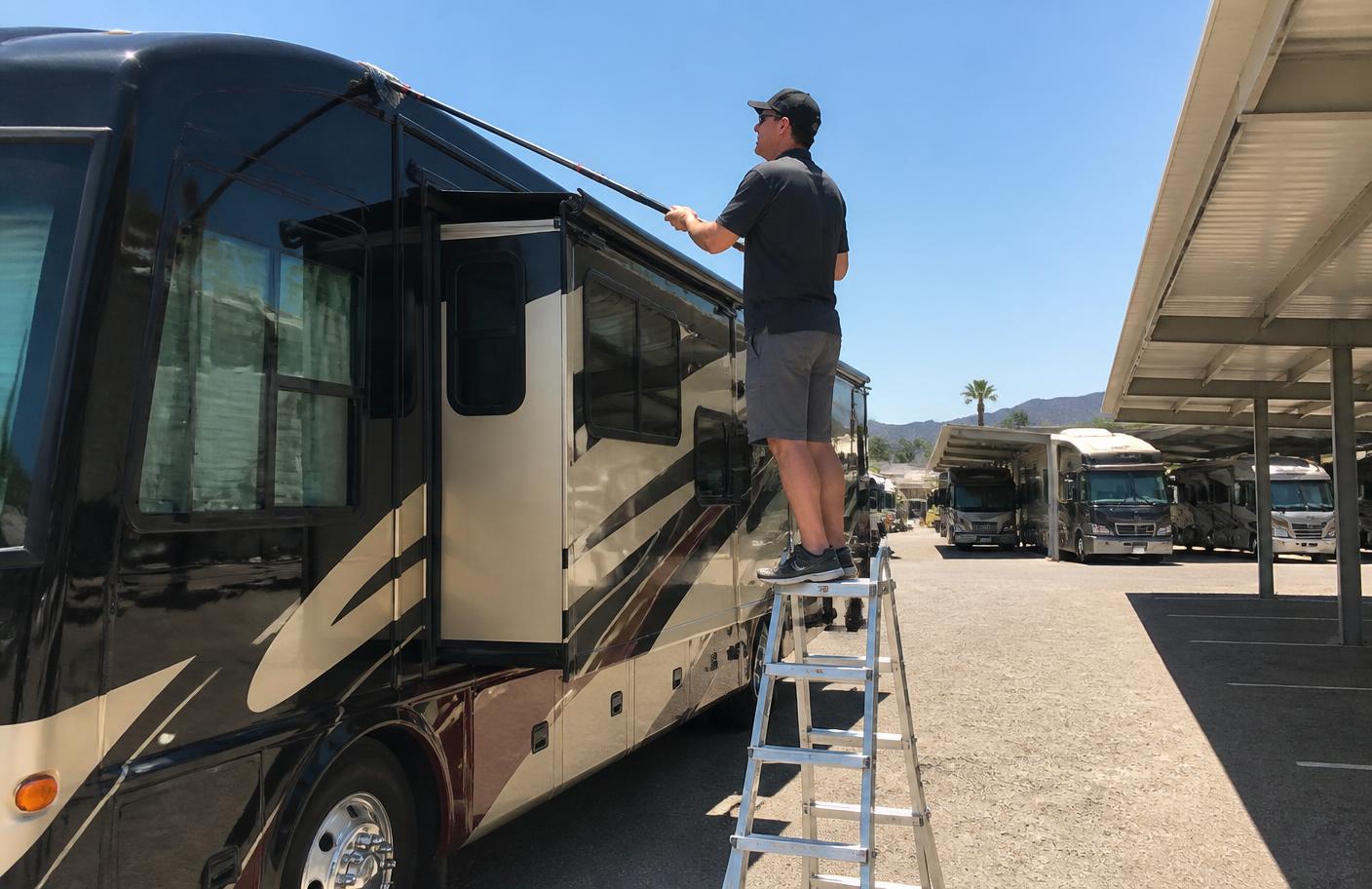
We work at residential driveways, private RV pads and side yards, storage facilities where outside vendors are permitted, commercial properties and business lots, and other accessible service locations. The practical requirement is space. We need enough clearance to walk and work all the way around the unit, room to stage equipment, and — for upper-surface work — overhead clearance and a stable, level place to set a ladder or platform.
One honest caveat: not every HOA, storage facility, or property manager allows mobile detailing or wash-water runoff on site. Rules vary widely across the Valley. If your RV lives somewhere with a gate and an office, confirm permission before we schedule so we are not both surprised on the day.
Scope
RV detailing vs. RV washing
People search for both, and they are genuinely different levels of service. Neither one is "better" — they solve different problems, and the right choice depends on the coach's condition and what you want out of the appointment.
RV wash
Focused on removing what has landed on the exterior: desert dust, road grime, baked bugs, streaking, dirt, and general contamination across the sidewalls, caps, glass, and lower panels. This is the maintenance service — the thing you book before a trip, after a trip, or every few weeks while the RV sits outside.
RV detailing
A deeper exterior process: decontamination, wheels and tires, trim, targeted spot and streak treatment, an honest evaluation of oxidation and chalking, optional exterior protection, and problem-specific work on the areas that a wash alone will not resolve. Interior cleaning can be included when it is agreed up front.
We do not force RVs into fixed packages. The scope is built from the coach's condition and your goals, which is also why the estimate comes after we know what we are looking at.
Why it's different
Why RV detailing is not car detailing
The obvious difference is scale. A large motorhome can carry more exterior surface than four or five passenger cars, and most of it sits above eye level. Height changes everything about the workflow: reach, media choice, how runoff travels down the panel, and how long a section can be worked before product dries in the sun.
The less obvious difference is materials. On one coach you can encounter fiberglass, gel coat, painted panels, vinyl decals and graphics, rubber seals, plastic trim, oversized windows, aluminum siding on some builds, awnings and awning rails, and heavy wheels and tires. Each of those has its own chemical tolerance. A strong degreaser that is fine on a lower skirt can dull a decal edge. An acidic wheel cleaner that shifts brake dust quickly can stain trim. Gel coat that has already begun chalking reacts very differently from healthy paint.
High pressure is the other common source of damage. Blasting a seam, seal, vent, decal edge, or window frame with a narrow high-pressure jet can lift a decal, drive water past a seal, or force it somewhere it should not be. We use controlled pressure, soft media, and surface-appropriate chemistry with dwell time — slower per panel, and far less likely to cost you a repair.
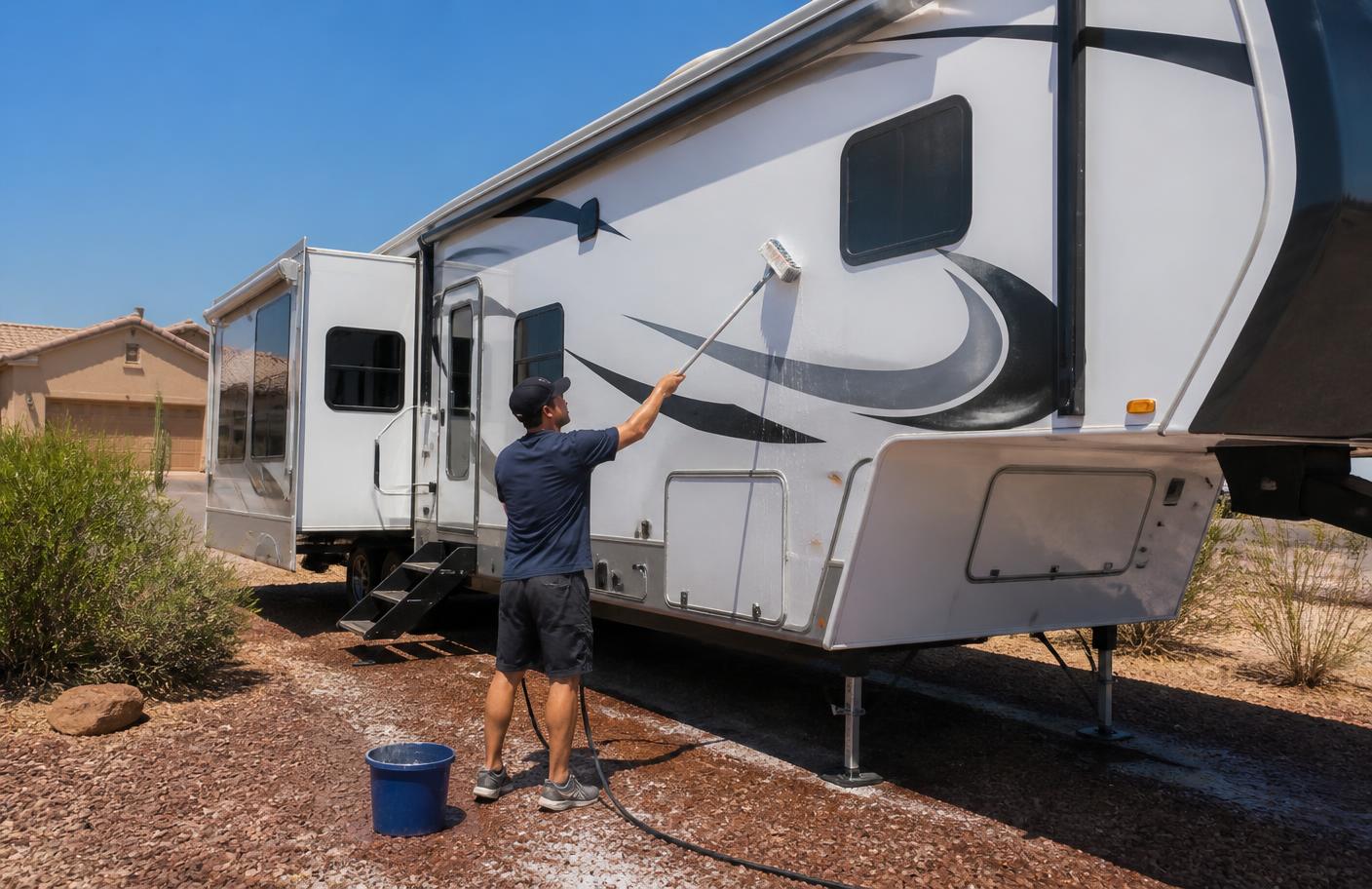
Exterior workflow
How a professional RV exterior wash runs
The order matters as much as the products. Working top-down keeps dirty runoff from crossing surfaces that have already been cleaned, and sectioning the coach keeps soap and treatments from flashing dry on hot panels. A typical exterior sequence covers pre-inspection, a controlled rinse, surface-appropriate soap on the sidewalls, front cap and rear cap, bug treatment, black streak treatment, windows and trim, lower skirts, wheels and tires, and a deliberate drying stage.
What a wash will not do is remove every contaminant on the coach. Bonded deposits, mineral etching, hardened tree sap, and staining in oxidized surfaces need dedicated decontamination or correction steps that belong to a deeper detail. We will point out anything a wash leaves behind rather than letting you discover it afterward.
Problem area
Black streak removal
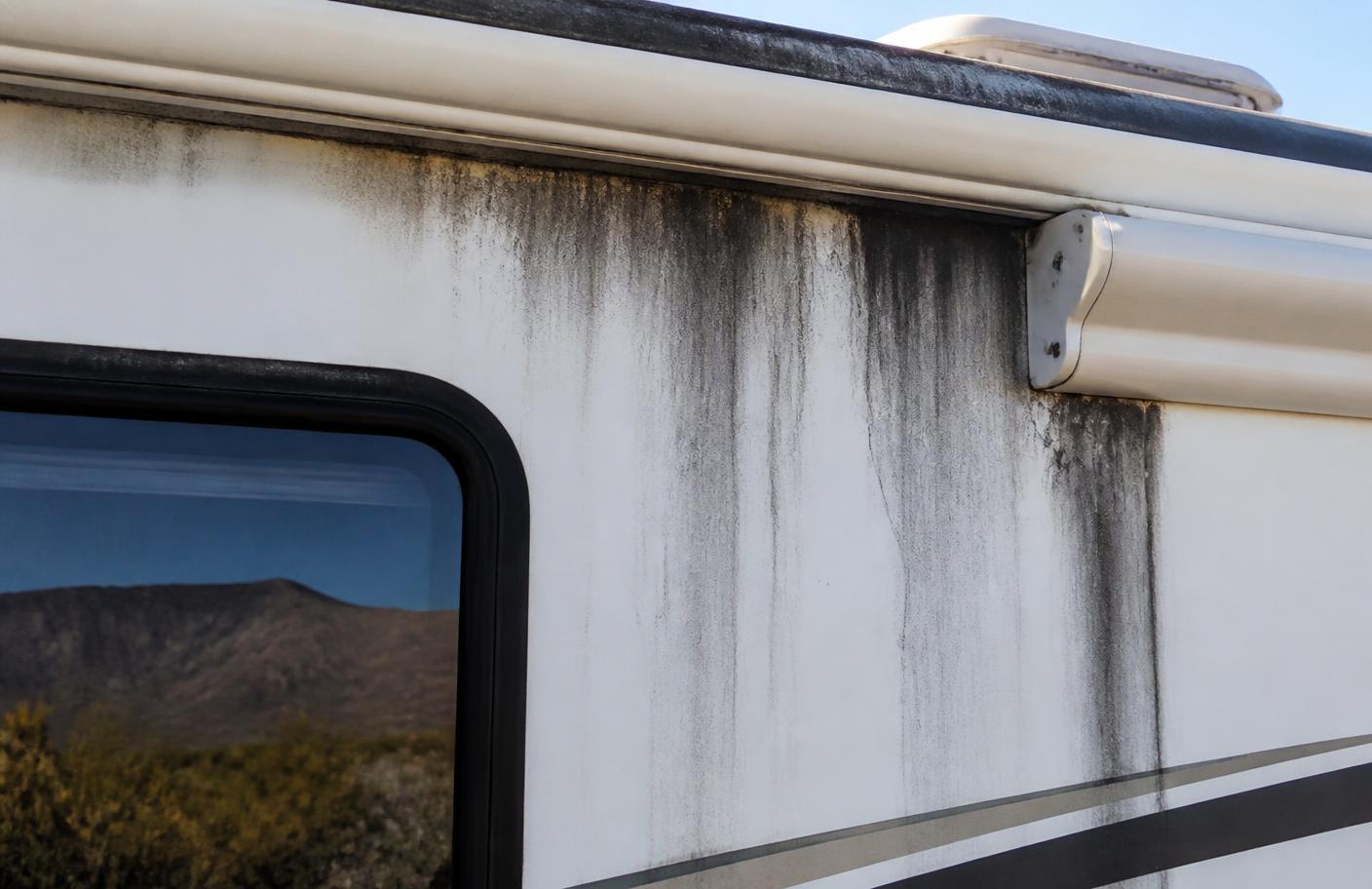
Black streaks are the signature RV problem. They form when rain and condensation carry dirt, oxidized residue, and sealant breakdown down the sides of the coach from above — which is why they start at the roofline, awning rails, window frames, gutters, trim edges, and drainage points and run vertically down otherwise clean sidewalls.
Ordinary car soap generally will not touch them. Streaks need dedicated streak remover with adequate dwell time and gentle mechanical agitation, worked section by section from the top down. On healthy gel coat the improvement is usually dramatic. On surfaces that have already oxidized or gone porous, staining can lighten rather than vanish — and if the source above keeps producing runoff, streaks will come back, which is one of the main reasons owners move to a maintenance schedule.
Problem area
Bug removal and front-cap cleaning
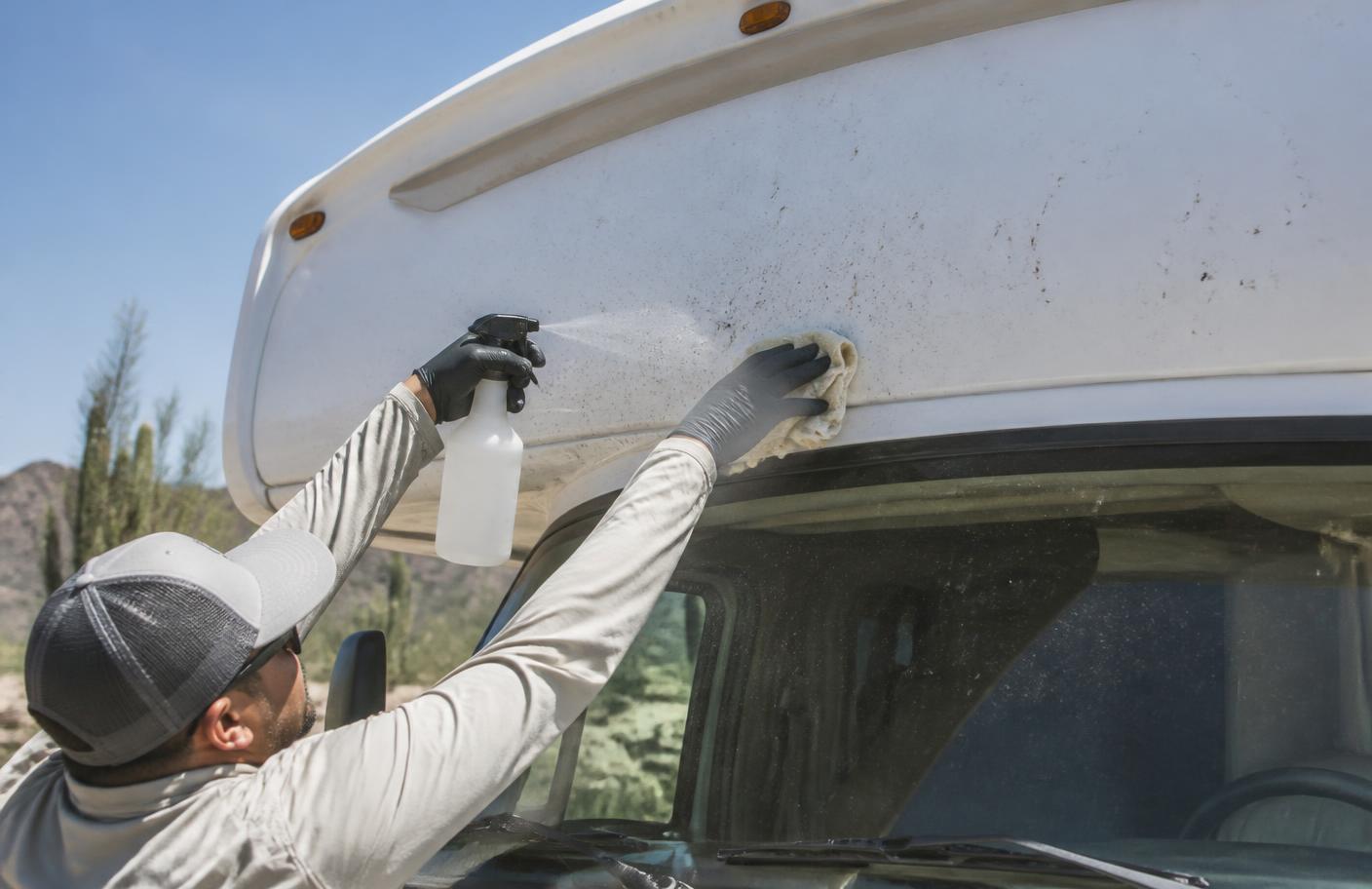
Arizona highway miles put a dense layer of insect residue on the front cap, mirrors, and windshield surround, and desert heat bakes it on fast. Bug remains are protein-based; once they have cooked onto a hot cap they bond to the surface and start to etch it if left for weeks.
The correct approach is chemistry and patience — a bug-specific product, enough dwell time to soften the residue, and light agitation with soft media, repeated if necessary. Aggressive dry scrubbing or a high-pressure jet at close range is what marrs caps and lifts decal edges. If residue has already etched the surface, we will say so instead of scrubbing harder.
Condition
Oxidation, chalking, and faded RV surfaces
The single most useful distinction for an RV owner in Phoenix: dirt is not the same as surface degradation. Dirt sits on the coach and comes off. Degradation is the surface itself breaking down from years of UV exposure.
A wash removes contamination. It does not, on its own, repair heavy oxidation, chalking that leaves white residue on your hand, gel coat that has begun to fail, cracked or shrinking decals, or peeling finishes. Light oxidation on compatible surfaces can sometimes be improved, and we will tell you after looking at the coach — but restoration-level work on badly degraded gel coat is a different trade from detailing, and we would rather turn that job down than take your money for a result the surface cannot produce.
In practice, most Phoenix RVs land somewhere in the middle: sound surfaces with a season of contamination, plus a chalky upper band on the areas that face the sun hardest. Those coaches clean up very well.
Protection
RV wax and paint sealant
Exterior protection is optional and worth discussing where the surface supports it. On sound gel coat or painted panels, a wax or sealant adds a sacrificial layer that takes the abuse instead of the surface, makes the next wash noticeably easier, slows how aggressively dust and road film bond, and improves gloss on compatible finishes.
What it does not do is stop UV damage. It reduces and delays; it does not exempt a coach from the Arizona sun, and it needs re-application on a schedule that depends on exposure. Which product makes sense depends on the surface type, its condition, and your goals — on heavily oxidized surfaces, protection alone is the wrong first step.
If you also own a car or truck that lives outside, the same logic drives our exterior hand wash and wax service, and for compatible painted automotive surfaces, ceramic coating is the longer-term version of the same idea.
RV wheels and tires
RV wheels collect brake dust and heavy road grime, and the tires carry both film and Arizona UV exposure. Wheels are cleaned with products matched to the finish — polished aluminum, painted, and simulator covers all have different tolerances — and tires are scrubbed rather than simply dressed over, then treated with a water-based product where you want them dark. We are describing appearance work here, not making claims about tire condition or lifespan; anything structural should be assessed by a tire professional.
Roof and upper-surface cleaning
Upper-surface work is scoped for the individual coach rather than promised in advance. Whether it happens depends on RV height, roof construction and condition, overhead and side clearance at the location, whether the site allows safe ladder or platform setup, and whether roof access is appropriate at all on that particular unit. We do not walk every RV roof. When the roof itself is not safe or suitable to access, we will tell you and focus on the upper sidewalls and roofline edges that can be reached properly.
Coach types
Class A, B, C, fifth wheels, and travel trailers
Class A motorhomes
The biggest job on the list: long, tall sidewalls, a large front cap that takes the full bug load, a rear cap that collects road film, extensive glass, and heavy wheels. Access and height planning drive the appointment.
Class B / camper vans
Smaller and quicker, but Phoenix still delivers the same road film, bug residue, and sun exposure. Vans often have painted automotive surfaces, which opens up more protection options.
Class C motorhomes
The cab-over section and upper surfaces need particular attention — they trap dust, take direct sun, and are where streaking typically begins on these coaches.
Fifth wheels
Tall front caps and high upper sections, plus the contamination that builds up during long stretches parked in storage. Reach and safe access matter more here than raw square footage.
Travel trailers
Big flat sidewalls with extensive decals, roofline runoff streaking, and heavy outdoor-storage exposure. Decal-safe chemistry is the main constraint.
Toy haulers and larger trailers
Everything a travel trailer has, plus a ramp area and lower panels that see more grime. Interior work, when included, is usually the bigger variable.
Inside
RV interior detailing
Interior work is available and scoped before the appointment. That typically means vacuuming throughout, hard surfaces such as counters, tables, cabinet faces and dash, upholstery and soft seating, interior glass, entry areas and steps that track in the most dirt, dust that collects in storage compartments and around vents, and pet hair where that is part of the problem.
We do not do appliance repair, plumbing work, mattress cleaning, or dismantling fixtures. For cabins that need serious attention, the techniques are the same ones behind our interior deep cleaning and odor elimination work — worth mentioning if a coach has been closed up through a Phoenix summer.
Logistics
RV storage facility detailing
A large share of Valley RVs live in storage, so this comes up constantly. Some Phoenix facilities are happy to let mobile detailers work on site. Others restrict outside vendors entirely, or require insurance documentation and check-in at an office. Many have rules about water use and where runoff can go, and covered or enclosed spaces frequently limit height, side clearance, and ladder setup.
None of that is a dealbreaker — it just needs confirming first. Ask your facility whether an outside mobile detailer is permitted, whether wash water is allowed, and whether the coach can be pulled forward into open space for the appointment. If it cannot, a nearby permitted location often works instead.
Estimates
What we need to quote your RV
- — RV type (Class A, B, C, fifth wheel, travel trailer)
- — Approximate length
- — Year, make, and model if you know it
- — Current exterior condition
- — Storage history — indoors, covered, or outdoors
- — Any oxidation or chalking you have noticed
- — Black streaking along the roofline and windows
- — Bug contamination on the front cap
- — Whether you want a wash or a deeper detail
- — Whether you want exterior protection
- — Whether you want interior work included
- — ZIP code or service location
- — How much open space surrounds the RV
- — Storage facility permission, if applicable
Photos of the sidewalls, front cap, and roofline help more than anything else on this list — they tell us in seconds what a phone description takes ten minutes to approximate. You can describe them in the estimate form and we will follow up about sending them.
Cost
How much does RV detailing cost in Phoenix?
We do not publish RV prices, and we do not quote by length alone, because length is only one of the inputs. What actually determines the number is length and height, total surface area, current condition, contamination level, oxidation and streaking, site access, exterior-only versus interior-and-exterior scope, wheels, protection choices, location, and the total labor hours all of that adds up to.
Consider the two ends of the range. A 25-foot travel trailer washed every few weeks, stored under cover, no streaking, light dust: straightforward maintenance work. A 40-foot Class A parked outdoors for a year with chalked upper sidewalls, heavy black streaking down every window frame, a baked front cap, and brake-dusted wheels: a fundamentally different job that can take multiples of the time. Any business quoting both from the same price chart is guessing on one of them.
The Phoenix detailing cost guide walks through the same factors in more detail if you want the reasoning before you call.
How long does RV detailing take?
There is no universal answer, and quoting one would be dishonest. Duration tracks RV size, current condition, whether you booked a wash or a deeper detail, how much oxidation and streaking has to be worked, whether protection is applied, whether interior work is included, and how good the access is at your location. We give you a realistic window with the estimate and tell you if the coach's condition means the appointment should be split.
RV maintenance detailing
A coach that gets washed and protected on a routine stays easy to clean. One that goes years between cleanings turns into restoration-level labor, because contamination has had time to bond and the surface has had time to degrade. Common trigger points here are before travel season, after a long trip, before going into storage, after coming out of storage, and periodic upkeep while the RV sits outdoors. We will not prescribe a single universal schedule — exposure, storage, and use vary far too much between owners.
Honest limits
When an RV needs more than detailing
Detailing is cleaning, protection, and cosmetic improvement. It is not a repair trade, and there are conditions we will refer out rather than take on:
- — Failing gel coat that has degraded past cleaning or improvement
- — Structural fiberglass damage, delamination, or soft spots
- — Roof membrane damage, tears, or failing roof sealant
- — Cracked, peeling, or flaking paint and finishes
- — Broken or dried-out seals around windows, doors, and roof penetrations
- — Collision or body damage
- — Any mechanical, electrical, or plumbing problem
Those belong with an RV repair or body specialist. If we spot something in that category during the walkthrough, we will point it out — a clean coach with a leaking roof seal is still a problem.
Coverage
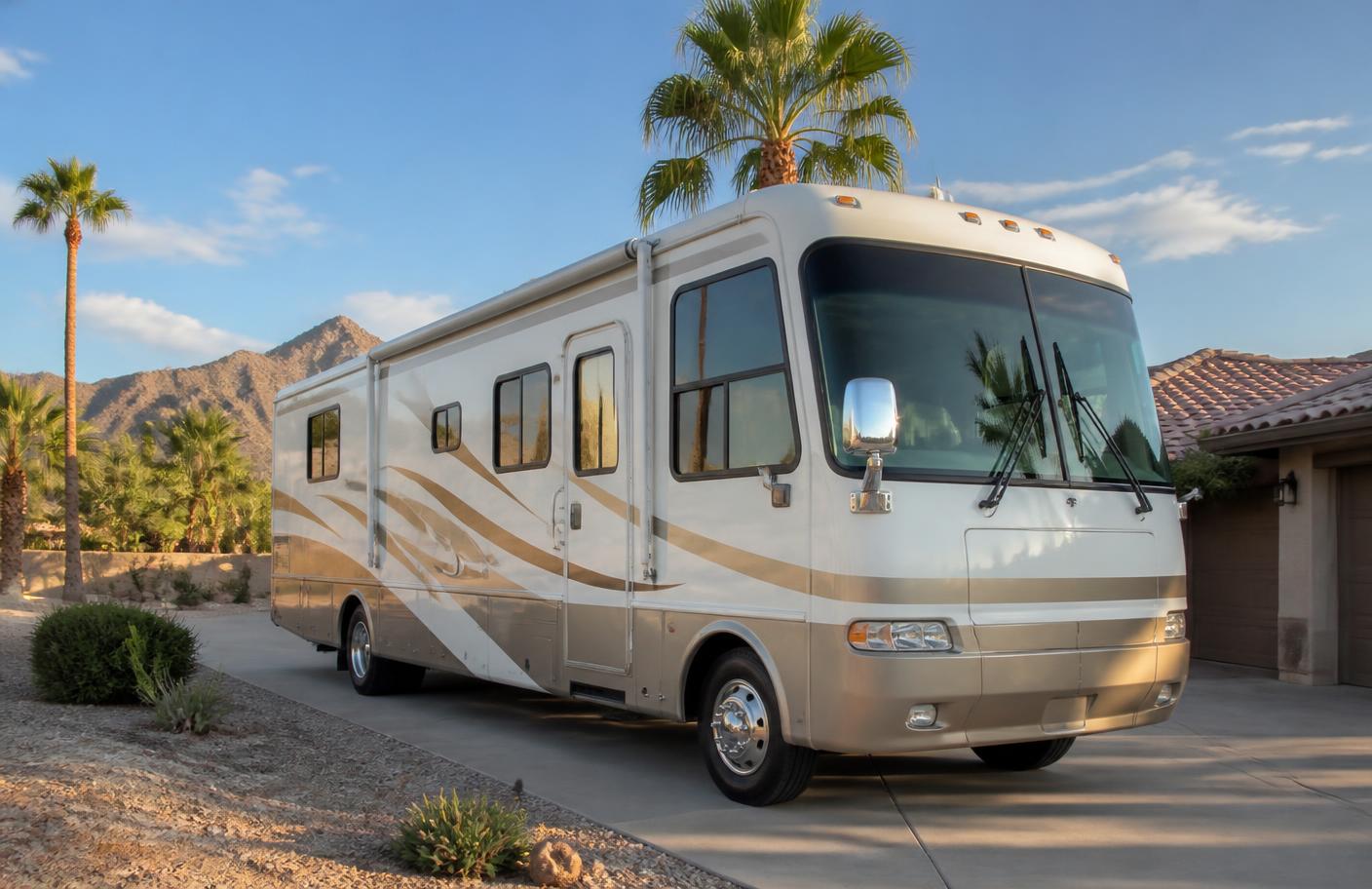
RV detailing across Phoenix and the Valley
We cover Phoenix and the surrounding Valley, including North Phoenix, Desert Ridge, Surprise, Peoria, Goodyear, Mesa, Gilbert, and Scottsdale. RV work skews toward the outer valley simply because that is where the pads and storage lots are, but larger coaches are parked all over the metro. See the full areas we serve list, or browse all detailing services if you also have cars or work vehicles at the same location — recurring on-site programs are covered under fleet detailing.
Questions
RV Detailing & Wash FAQ
- Do you offer mobile RV detailing in Phoenix?
- Yes — mobile is how we work. We bring water, power, and equipment to the RV at your home, private pad, an accessible storage space, or a commercial property, as long as there is enough working room around the coach and the location permits the work.
- How much does RV detailing cost in Phoenix?
- It is quoted per RV, and we do not post flat prices. Length, height, total surface area, current condition, oxidation and streaking, bug load, wheels, whether you want exterior only or interior as well, protection choices, and site access all change the labor involved. The Phoenix detailing cost guide explains the same factors in more detail.
- Do you offer RV washing in Phoenix?
- Yes. A wash focuses on removing dust, road grime, bugs, streaking, and general contamination from exterior surfaces. Detailing goes further — decontamination, targeted problem work, wheels and trim, oxidation evaluation, and optional protection. Many owners alternate: regular washes with a deeper detail occasionally.
- Do you wash Class A motorhomes?
- Yes, and they are among the most common requests. Large sidewalls, front and rear caps, extensive glass, and commercial wheels mean the appointment is scoped around access and height at your location.
- Do you clean travel trailers and fifth wheels?
- Yes. Travel trailers bring big flat sidewalls, decals, and roofline runoff; fifth wheels add tall front caps and upper sections. Both are usually stored outdoors here, so contamination levels are typically higher than on a coach kept covered.
- Can you detail an RV at a storage facility?
- Often, but not always. Some Phoenix facilities welcome mobile vendors, others restrict outside contractors, and many have rules about water use and runoff. Covered spaces can also limit height and working clearance. Please confirm permission with the facility before we schedule.
- Can you remove black streaks from an RV?
- Usually we can improve them significantly with dedicated streak treatment along the roofline, awning rails, window frames, and gutters. Long-standing staining on oxidized or porous surfaces may lighten rather than disappear, and streaks come back if the runoff source above keeps producing them.
- Can RV detailing remove oxidation?
- Light surface oxidation and chalking can sometimes be improved on compatible surfaces, and we will tell you honestly after inspecting the coach. Heavy oxidation or failing gel coat is a restoration-level job rather than a detail, and we will not claim a wash fixes it.
- Do you wash RV roofs?
- Roof and upper-surface work is evaluated per RV rather than promised. It depends on coach height, roof construction and condition, overhead clearance, the site, and whether access can be done safely. We do not walk every RV roof, and we will say so on site if it is not appropriate on yours.
- How long does RV detailing take?
- It varies too much for a universal number. A maintenance wash on a smaller, regularly cleaned trailer is a fraction of the work required on a long Class A with heavy streaking, baked bugs, and a season of outdoor storage. We give you a realistic window with the estimate.
- Do you need water or power from me?
- No. We arrive self-contained with our own water and power, which is what makes storage lots, business properties, and apartment-style parking workable. If a site has usable hookups and permits their use, that is fine too.
- Can you detail an RV in Phoenix summer?
- Yes, with early-morning starts and shade or covered space wherever possible. Hot panels dry water and product too fast, so summer appointments are scheduled and sectioned around heat rather than run through the middle of the afternoon.
- How often should an RV be washed in Arizona?
- There is no single schedule. Common triggers here are before travel season, after a long trip, before going into storage, after coming out of storage, and periodically while parked outdoors. An RV washed and protected on a routine is far less labor to maintain than one cleaned once every few years.
- Do you detail RV interiors?
- Yes, when it is agreed in advance — vacuuming, hard surfaces, upholstery, interior glass, entry areas, storage dust, and pet hair where relevant. We do not do appliance repair, plumbing work, mattress cleaning, or fixture dismantling.
- What information do you need for an estimate?
- RV type and approximate length, year, make and model if you know it, current exterior condition, storage history, whether there is oxidation, chalking, black streaking or heavy bug contamination, whether you want a wash or a deeper detail, interest in exterior protection, any interior work, your ZIP or service location, how much space surrounds the RV, and facility permission if it is in storage. Photos help a lot.
Services that pair with this
Exterior Hand Wash & Wax
Contact-safe hand wash, wheels and tires, bug and tar removal, and a durable sealant or wax finish.
Fleet & Commercial Vehicle Detailing
Recurring, on-site cleaning programs for work vans, pickups, service trucks, and company vehicles.
Overspray Removal
Removal of paint, stucco, and industrial overspray from paint and glass using clay, chemical, and mechanical stages.
Booking this in your area
Popular locations for this service: North Phoenix, Surprise, Mesa. See every area we cover.
Book rv detailing & rv wash in Phoenix
Tell us about the vehicle and where it's parked and we'll put together a realistic estimate. Prefer to talk it through? Call (623) 244-4484.
Browse all 14 detailing services or read the Phoenix detailing cost guide.